The first thing you hear is the slow breath of twenty strangers trying to be calm.
The second is the sticky whisper of bare feet on rubber, as a wave of people folds into downward dog.
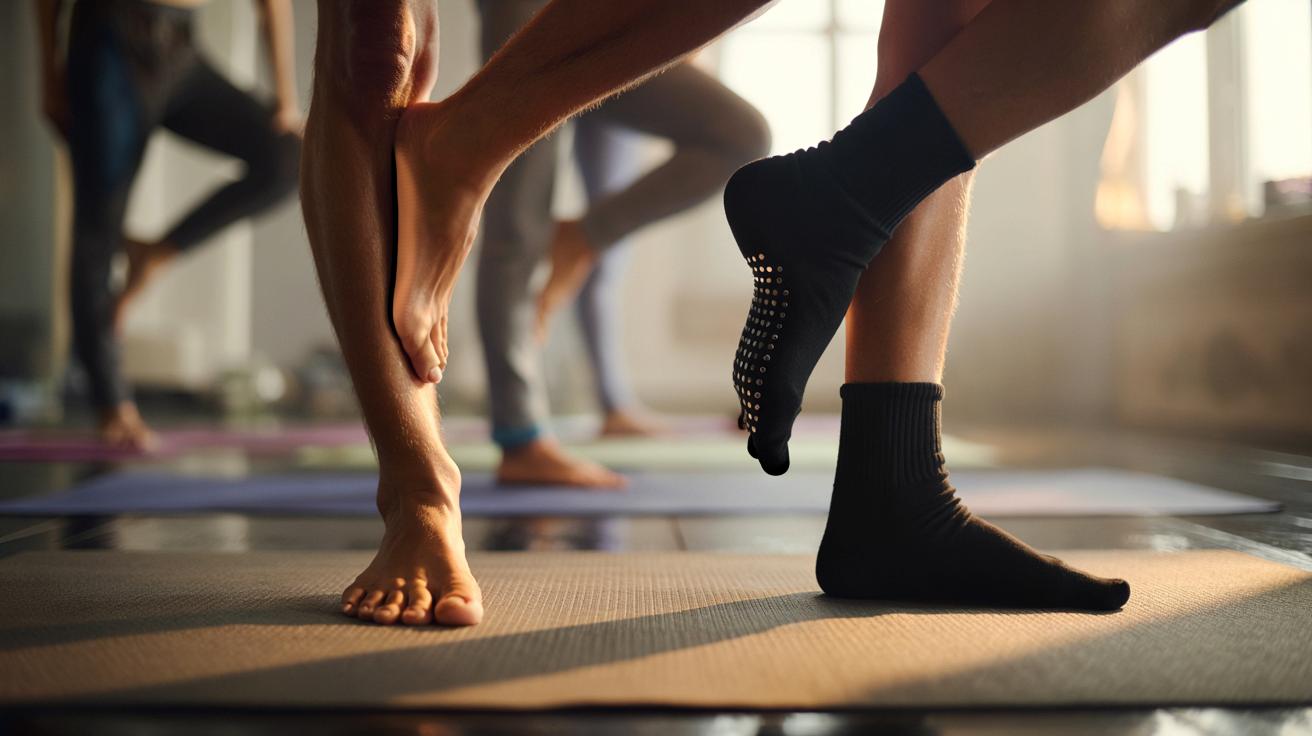
At the back of the studio, one woman quietly tugs on a pair of black grip socks, tiny silicone dots shining like constellations. Next to her, a guy is barefoot, toes fanned wide, testing the mat as if it were sand. Same pose, same teacher, same playlist.
Yet when they balance on one leg, something tiny but real splits their experience in two.
And once you notice it, you can’t quite unsee it.
Why your feet quietly rewrite your entire yoga practice
Watch a yoga class from the floor, at mat level, and the story is all in the feet.
Some are rooted, toes spread like starfish, gripping the mat with small, animal intelligence. Others stay tucked inside fabric, cushioned and steady, anchored by the grippy patterns hiding under the heel.
The poses might look identical from the waist up.
Yet down there, tiny muscles in the arch, ankle and calf are working in completely different ways.
Researchers have started to measure this with force plates and EMG sensors.
What they’re seeing is simple yet surprising: doing yoga barefoot or with grip socks doesn’t just change your comfort level.
It subtly shifts balance strategies, muscle activation patterns and how your nervous system negotiates each wobble.
A small study out of a European sports science lab asked participants to hold tree pose on a pressure-sensing platform.
One condition: barefoot.
The other: wearing non-slip socks designed for yoga and Pilates.
The overall sway didn’t vanish with socks, but the pattern changed.
Barefoot, people tended to use more micro-adjustments from the toes and the tiny muscles of the sole. With socks, the body leaned more on the ankle joint and larger leg muscles for control.
Another experiment looking at single-leg stance showed similar differences in EMG readings.
Barefoot conditions lit up the intrinsic foot muscles more intensely, while grippy socks softened that demand and shifted load just slightly upward.
On the outside, both versions looked “stable”, yet their neuromuscular story was not the same.
Why would a few millimetres of fabric do all this?
Because your foot is not just a passive thing at the end of your leg.
➡️ The small habit that prevents feeling behind before the day starts
➡️ Place a single ice cube on your orchid once a week and watch the blooms return
➡️ How emotional reactions can be shaped by tone more than content
➡️ Foil behind radiators: the installation angle that determines whether you save anything at all
➡️ Finding gold while digging a pool raises one legal question that decides everything
➡️ Tomato acidity drops with baking soda but so does brightness
➡️ Baking soda under-eye hacks: the irritation risk nobody mentions and safer options
Under the skin live thousands of sensory receptors feeding constant data to your brain about pressure, stretch, vibration and temperature.
Bare soles on a mat send raw, high-resolution information, like switching your phone camera to 4K. Grip socks, even the thin ones, filter that signal a touch, and add a hint of extra friction.
That mix changes how your brain anticipates slippage and organizes balance.
With more grip, your nervous system may “trust” the surface more and recruit fewer toe-grabbing strategies. With bare feet, it gets richer tactile feedback and calls on more of the small stabilizers.
Neither is right or wrong, yet they are distinctly different training environments for your whole lower body.
How to choose between barefoot and grip socks without overthinking it
Start by treating your feet like part of the practice, not just the things that carry you to the mat.
Before class, stand in mountain pose twice: once barefoot, once with grip socks.
Notice what changes, slowly.
Do your toes naturally spread more without fabric, or do you feel safer with that tiny layer and extra traction? Does one option make balancing feel “cheatable”, or does it finally quiet down your fear of slipping?
The goal is not to prove that one is superior.
The goal is to become honest about which environment makes your body tense and which unlocks just enough ease to explore your edge.
We’ve all been there, that moment when the teacher cues half-moon and your mind screams: “I’m going down.”
This is where tiny choices like socks or no socks stop being “just gear” and start being nervous system management.
If you’re recovering from an ankle sprain, dealing with hypermobility, or practicing on a cold or dusty floor, grip socks can reduce the mental noise around slipping. That matters.
For beginners, that extra perceived safety often means they’ll actually try the pose instead of shortening the stance out of fear.
On the flip side, people who’ve worn shoes for most of their lives often have sleepy foot muscles. Barefoot practice can gently wake those up, one wobbly warrior at a time.
Let’s be honest: nobody really does this every single day.
Yet even one or two barefoot sessions a week can start teaching your feet forgotten skills.
“I used to insist on everyone being barefoot,” admits Laura, a yoga teacher in Berlin who now keeps a basket of clean grip socks by the door. “Then I realized some students were so scared of slipping that they never moved past the basics. With socks, they actually explored. The funny thing is, after six months, many of them chose to go barefoot on their own.”
Her approach blends both worlds.
She encourages students to think in terms of *options*, not rules, rotating between three simple setups:
- Barefoot on a sticky mat for full sensory feedback and intrinsic foot strength
- Thin grip socks on a mat when anxiety, hygiene, or chilly studios get in the way
- Occasional barefoot practice on firmer, less forgiving surfaces to sharpen balance and awareness
That small, flexible system respects different bodies and different days.
Because your needs on a confident Monday night vinyasa are not the same as your needs during a fragile, post-workout Friday yin class.
What this means for your body, your ego, and your long game
Once you start paying attention to your feet in yoga, you might notice other quiet truths.
The side you always wobble on. The poses where your toes claw the mat so hard they cramp. The way grip socks feel like a relief on days your joints feel unpredictable.
Over time, alternating between barefoot and grippy sessions can turn into a micro-cycle for your nervous system.
Barefoot days become training for awareness, strength and adaptability.
Sock days become training for confidence, range and fluidity.
There’s a plain-truth angle here: most of us are not elite yogis.
We’re people trying to squeeze 60 minutes of semi-conscious movement between emails and dinner. On that scale, the “perfect” choice doesn’t matter as much as the one that keeps you coming back to the mat.
The science suggests each option nudges muscle activation and balance in a specific direction.
Your job is to listen, experiment, and notice which direction you need more of this season of your life.
Some days, stability at all costs. Other days, a little bit of destabilizing wobble that reminds you you’re still learning.
| Key point | Detail | Value for the reader |
|---|---|---|
| Barefoot changes muscle activation | Engages intrinsic foot muscles and increases sensory feedback from the sole | Helps develop natural balance, grip and body awareness over time |
| Grip socks shift how you balance | Extra traction reduces slippage and leans more on ankle and leg muscles | Boosts confidence in standing poses, especially for beginners or after injury |
| Mixing both is a long-term strategy | Alternating barefoot and socks creates varied neuromuscular challenges | Offers a realistic, adaptable way to progress without rigid rules or guilt |
FAQ:
- Is barefoot yoga “better” than using grip socks?Not universally. Barefoot tends to strengthen foot muscles and refine balance, while grip socks support confidence and traction. The best choice is the one that helps you practice consistently without pain or fear.
- Can grip socks weaken my feet over time?They can slightly reduce demand on small foot muscles if you only ever use them. Rotating in regular barefoot sessions or foot-strengthening exercises balances this out.
- Are there people who should avoid barefoot yoga?Yes: those with certain foot infections, fresh wounds, severe neuropathy, or specific post-surgery protocols. People with joint instability may also feel safer starting with grip socks under guidance.
- Do the tiny silicone dots on grip socks really make a difference?Yes. They change the friction between your foot and the mat, which shifts how your brain organizes balance and how much your toes “work” to hold poses.
- How can I experiment without buying lots of gear?Use what you have: try a few classes barefoot on a decent mat, then repeat the same sequence wearing any thin, non-slip socks you own. Notice balance, effort and anxiety levels, and adjust from there.