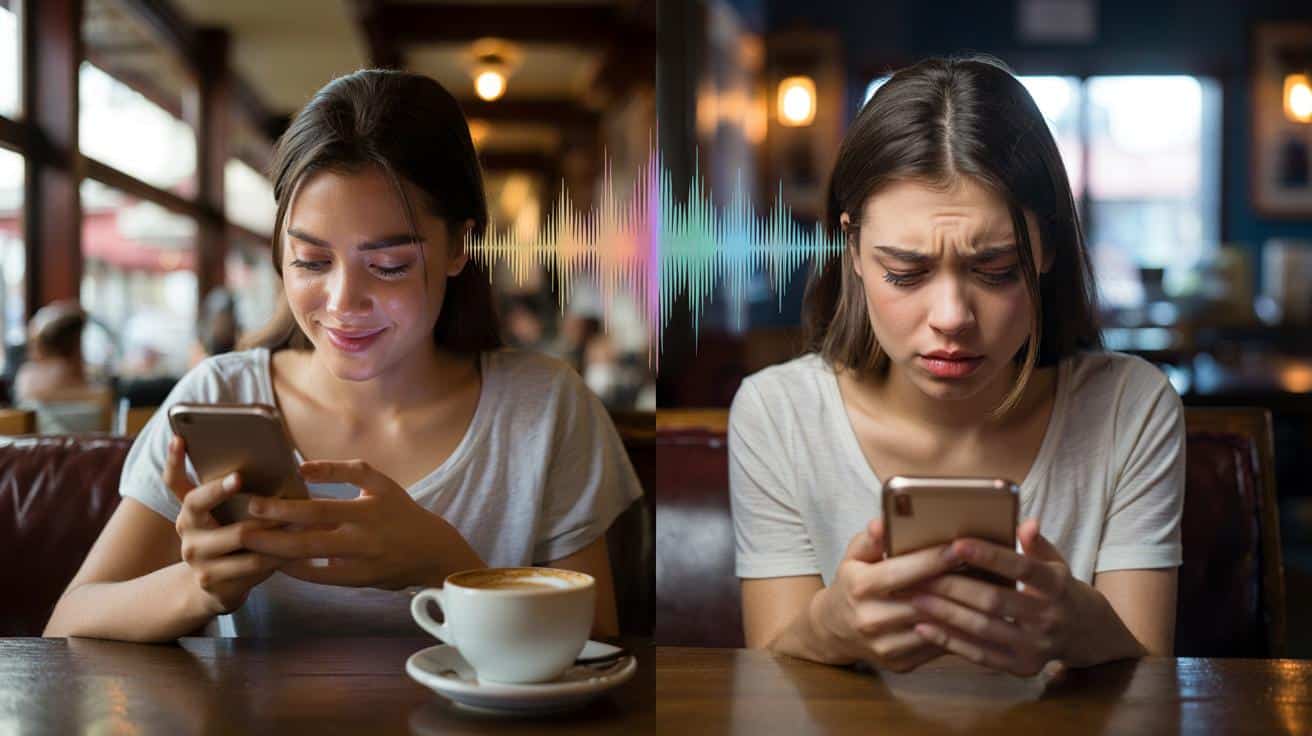
The café was too loud for bad news, yet that’s exactly where it landed.
Same words, two different mouths. One friend read my message out loud with a calm, almost warm tone. The other repeated it with a sharp little laugh at the end. Same sentence. Same screen. Completely different punch in the stomach.
I watched their faces as they listened. The first one shrugged, took a sip of coffee and said, “Sounds fair.” The second frowned. “Wow. That’s harsh.”
Nothing in the text had changed. Only the soundtrack in their heads.
That was the moment I started wondering: how many of our emotional reactions are about what’s said… and how many are just about the way it lands in our ears?
When tone quietly rewrites the story in your head
Scroll through your messages and you’ll see it. A neutral “Sure.” that felt icy. A “We need to talk” that made your chest tighten. On paper, these phrases are harmless. In your body, they can feel like a threat.
Our brains are constantly reading tone, like a background app that never closes. Pace, volume, rhythm, even the pauses between words. They all whisper clues: safe, unsafe, friendly, judging, bored, interested. Content comes in as data. Tone tells you whether to brace or relax.
That’s why a simple “How was your day?” can feel like care or interrogation. Same question. Different soundtrack.
We see it most clearly when tone and content don’t match. A compliment delivered through gritted teeth. An apology spoken like a PR statement. The words are clean, yet something inside you says: don’t trust this.
In 2017, a small study at the University of Essex played people the same sentence in different tones. Friendly, annoyed, sarcastic, flat. Participants knew the content stayed identical. Still, their emotional reactions moved with the tone, not the words. They judged the speaker’s motives. They changed how much they liked them. Their heart rate even shifted.
Think about the last work email that made you panic. Maybe the subject line was just “Quick question”. Neutral words. Your brain filled in the tone: rushed, critical, urgent. Suddenly you’re checking your performance, re-reading old messages, replaying yesterday’s meeting. The emotional storm came from how you *heard* those two words in your mind.
➡️ Place a single ice cube on your orchid once a week and watch the blooms return
➡️ Baking soda under-eye hacks: the irritation risk nobody mentions and safer options
➡️ Perfume fades faster on some people for a biological reason unrelated to skin type
➡️ Tomato acidity drops with baking soda but so does brightness
➡️ He hid an AirTag in his donated sneakers and tracked them to a surprising location
➡️ Snakes appear in gardens because food sources move in first
On social media, it’s even wilder. Without a voice, we grab at emojis, punctuation, capital letters, timing. Someone replies “OK” instead of “okayyyy 😊” and you feel a tiny sting. They didn’t say anything wrong. Your mind just picked a tone, like choosing the soundtrack to a film. And once the soundtrack is dark, every scene looks darker.
Neuroscientists often talk about the amygdala, the part of the brain that scans for danger. Tone is one of its favourite shortcuts. Angry voice? Sharp rhythm? Sudden volume change? The amygdala lights up before you’ve even processed the meaning of the sentence.
Content lives in the slower part of the brain, where language gets decoded and analysed. Tone hits the fast lane. That’s why you can “know” someone didn’t mean harm, yet still feel your stomach drop when their voice turns cold.
Our emotional memory also hooks into tone. The way a teacher used to say your name when you were in trouble. The sound of arguments in the next room when you were a kid. Years later, a similar tone can wake up old feelings, even if the situation today is harmless. Your body reacts first. Logic trails behind, trying to catch up.
How to speak so your tone carries what you really mean
There’s a quiet little skill that changes relationships: matching your tone to your true intention. Not in a polished, media-trained way. Just in a “I want you to actually feel what I’m trying to say” way.
A practical starting move is to slow down your first two sentences. When stakes feel high, we rush. The voice goes tight, higher, faster. That speed alone can sound annoyed or nervous, even if you’re just eager to get it over with. Breathe once, drop your shoulders, then speak a tiny bit slower than you want to.
It feels awkward. On the other side, it sounds like care.
One method therapists often use is “name your lane”. Before saying something sensitive, they quietly choose the tone they want to stay in: curious, kind, firm, light. Then they let that intention shape their rhythm and volume. You can do the same before a tough call: pick one word. Curious. Warm. Steady. Let it guide your voice.
Daily conversations are full of tiny tone traps. You’re tired and your partner hears it as annoyance. You’re stressed, and your child hears it as rejection. You think you’re being “direct”, your colleague hears aggression. On a busy day, nobody is setting out to hurt anyone. Yet tone, left on autopilot, does its own thing.
One useful habit is to repeat the emotional message out loud, not just the factual one. Instead of a flat “I’ll be late”, try “I’ll be late, *and I know that’s frustrating, I’m sorry*.” Same content, different emotional landing. The extra line softens your own voice as you say it.
On a screen, where tone has to travel without sound, little tweaks help. A short “hey” at the start. A “no stress” or “not urgent” when it’s true. Cutting down exclamation marks so they actually mean something when you use them. Soyons honnêtes : personne ne fait vraiment ça tous les jours. Yet those who do it even 30% of the time often find people around them relax.
If you want to test the power of tone, read this sentence out loud in three different ways: “We need to talk.” First, as if you’re furious. Then, as if you’re worried about someone you love. Finally, as if you’re excited with good news. Same content. In your body, three different movies.
Now imagine you’re on the receiving end and you only hear it once. You’d react in line with the tone you got. That’s what happens all day in offices, kitchens, group chats and group calls. We respond to the movie we *think* we’re watching.
That’s why couples’ therapists spend so much time on tone, not just arguments. A simple “I’m listening” can be healing, or infuriating, depending on how it sounds. We’ve all heard that version loaded with impatience. And we’ve felt the one that lands like a blanket.
“People will forget what you said, people will forget what you did, but people will never forget how you made them feel.” — often attributed to Maya Angelou
- Speak 10% slower than your stress wants you to, especially during conflict.
- Add one softening phrase to any hard message: “This might sound blunt, but I care.”
- After a tense moment, check in with tone, not content: “Did that come out harsher than I meant?”
Letting tone become a conscious choice, not an accident
On a quiet evening, pay attention to how people in your life sound when they’re kind, tired, distracted, secretly hurt. Not what they say. Just the texture of their voice, or the “tone” in their texts. Patterns start to appear, like learning the weather of a familiar city.
You begin to realise that what used to feel personal often isn’t. That clipped tone on a Monday morning? Maybe it’s sleep, or childcare, or money worries. Not a silent judgment about you. This doesn’t excuse truly harmful behaviour. It simply gives you more space to choose how much of that tone you take in.
On your side, you can start playing with micro-adjustments. Lower your volume slightly when talking about something hard. Add a breath before you say “no”. Soften your eyebrows when you say “I disagree”. These details sound almost silly written down. In real life, they work like emotional shock absorbers.
We all have that one person who can say uncomfortable things without making us feel small. Watch them closely. Often, they use a steady, grounded tone. No eye-roll baked into the words. No sigh at the end of a sentence. Their voice says: “You’re safe, even if we’re not on the same page.”
There’s another kind of person too: the one whose neutral sentences sting. Sarcasm baked into every syllable. Compliments that feel like performance reviews. They might swear they “didn’t say anything wrong”. And they’re right in one sense. The content passes HR. The tone does not.
We don’t always have the energy to tune our tone. Life is messy. Work is intense. On a bad day, you will snap at someone who didn’t deserve it. Or send a message that reads colder than you feel. The repair comes from naming it later: “I sounded sharp earlier. That was about my day, not you.” A little “parler vrai” like that can reset the emotional volume between you.
As you notice tone more, conversations stop being flat scripts and start looking like music. Crescendos, quiet bits, rough notes, surprising harmonies. Sometimes the lyrics are clumsy, yet the song still moves you. Sometimes the lyrics are perfect, yet the melody is all wrong.
We don’t control how others hear us. Their history, their mood, their fears all colour the sound. What we can shape is the way we send things out. The speed. The warmth. The sharp edges we sand down, not to fake anything, but to let our real intention show through.
The next time you feel an emotional wave rising from a single sentence, you might catch yourself asking a different question. Not “What did they say?” but “What tone did I hear… and is that the only possible soundtrack?” That tiny pause is where a whole new kind of conversation can start.
| Point clé | Détail | Intérêt pour le lecteur |
|---|---|---|
| Le ton précède le sens | La voix et le rythme touchent le cerveau émotionnel avant que les mots soient analysés | Comprendre pourquoi certaines phrases blessent ou rassurent sans raison logique |
| Le ton est modulable | Respiration, vitesse et intention consciente peuvent le transformer | Disposer de gestes simples pour rendre ses échanges plus apaisés |
| Le ton peut être réparé | Nommer un ton mal perçu permet souvent de relancer le dialogue | Éviter que de petits malentendus ne deviennent de grands conflits |
FAQ :
- Can tone really change how I remember a conversation?Yes. Your emotional memory is strongly tied to how safe or threatened you felt in the moment, and tone is a major signal of that safety.
- What if my natural tone sounds cold or blunt?You don’t need to change who you are. Small adjustments—slowing down, adding one sentence of context—can soften how you come across.
- Why do texts and emails cause so many misunderstandings?Written messages strip away most vocal cues, so your brain fills the gap, often with a more negative or anxious tone than the sender intended.
- Can I train myself to react less strongly to someone’s harsh tone?You can’t switch off your emotions, yet noticing “This is about their tone, not my worth” can reduce the intensity of your reaction over time.
- How do I fix a situation where my tone hurt someone?Go back and name it directly: acknowledge the tone, explain what was going on for you, and restate what you actually meant to convey.