The child is the first to see it.
A thin, silent curve of scales slipping between the flower pots, gone before the adult brain has even processed the shape. Heart rate spikes, gardening gloves freeze mid-air, and suddenly the sunny back garden doesn’t feel so friendly. In that instant, the question explodes in your head: why here, why my lawn, why now?
You look closer. A rustle in the compost. A flash of something small darting under the shed. The reality creeps in slowly: the snake is not the beginning of the story. It’s the end of a chain you hadn’t noticed starting.
Because before reptiles arrive, something else moves in first.
Why snakes appear in quiet, ordinary gardens
The first thing people say is, “I’ve never had snakes here before.”
They scan the grass like it’s turned into a jungle overnight, imagining nests and secret tunnels.
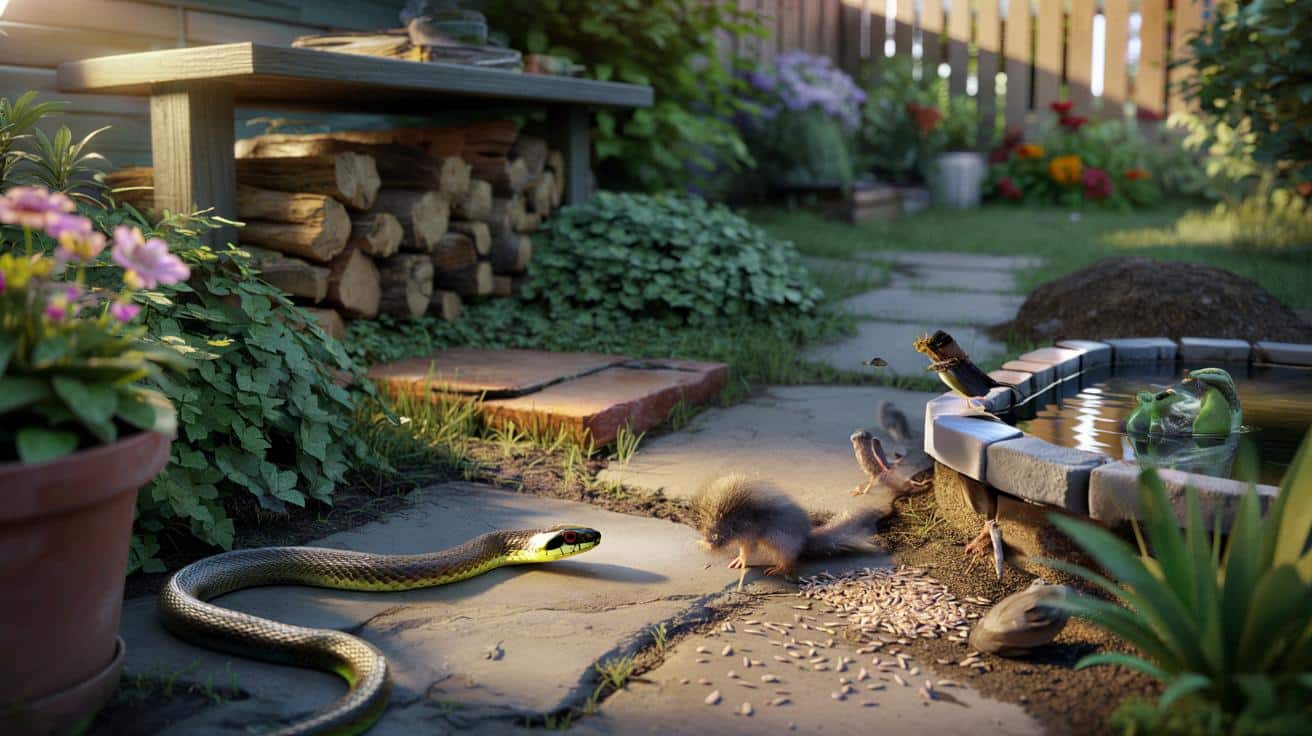
The truth is more prosaic. Most garden snakes aren’t wandering in by accident. They’re following a trail. Tiny bodies, soft fur, clicking beetle legs, frogs slipping between stones. *If you’ve suddenly got snakes, it’s almost always because your garden has quietly become a restaurant.*
Snakes don’t see your roses, your patio lights, your kids’ trampoline. They read a different map: smell of mice, warmth of compost heaps, vibrations of birds dropping to the ground. So the garden you see as “tidy enough” might look like a buffet laid out just for them.
Wildlife surveys from suburban areas in the UK, US and Australia tell the same story. Where small mammals, frogs and thick ground cover increase, snake sightings usually follow with a delay of a season or two.
It doesn’t happen overnight. Things build up quietly.
A bird feeder spills seeds under its pole, attracting mice and rats after dark. A neglected corner stacked with timber and old plant pots offers dry, safe tunnels. Slugs and snails hide under boards, frogs take the damp spots, insects explode in number.
Then one evening, a neighbour spots a grass snake in the rockery. A month later, someone finds a shed skin near the compost heap. The humans join the story late, when the top predator finally steps out from behind the curtain. The food web has been rehearsing for months without an audience.
Ecologists describe snakes as “meso-predators” in many garden ecosystems. They’re not the biggest players in the landscape, but they sit high enough in the chain to act like indicators. Where there are many of them, there’s usually plenty happening below.
➡️ The small habit that prevents feeling behind before the day starts
➡️ Orcas near ice shelves: what researchers track that signals real behavior change
➡️ Perfume fades faster on some people for a biological reason unrelated to skin type
➡️ How emotional reactions can be shaped by tone more than content
➡️ How emotional expectations shape disappointment more than actual events
➡️ Baking soda under-eye hacks: the irritation risk nobody mentions and safer options
Think of your garden like a layered cake. At the bottom: seeds, leaves, mulch. On that: insects, slugs, worms. On that: birds, voles, mice, frogs. Snakes rest on the top tier, quietly linking it all together. Remove the crumbs and the cake falls apart. Add more crumbs, and the top layer thickens.
This is why simply “hating snakes” never really works as a strategy. The animal you see is only the visible symptom of a deeper pattern. Food moved in first. The snake just followed the signal.
How to make your garden less attractive to snake food
The fastest way to change snake behaviour in your garden is to change what they come for.
That means thinking like a mouse, a frog, a small bird, before you think like a snake.
Start with food spills. Bird feeders are classic hotspots: seeds fall, rodents arrive after dark, snakes arrive once the rodents settle in. Use trays to catch excess seed, move feeders away from dense ground cover, and rake underneath once a week. It takes minutes, but it breaks a chain.
Next, look at water. Decorative ponds, leaky hoses, saucers under plant pots – they all draw amphibians and insects. If you keep water, fine, but trim back thick vegetation at the edges and remove floating clutter where prey can hide all day out of sight.
Most people worry about snakes long before they even glance at where mice live.
And yet, that’s where most gardens quietly recruit their first reptile visitors.
Rodents love what we “park for later”: wood piles resting directly on soil, cardboard boxes in sheds, old bags of compost, clutter behind the greenhouse. Each forgotten stack gives them shelter, warmth and endless hiding spots. Soon there’s a well-established colony, and snakes read that like a glowing sign in the dark.
Try raising wood piles on bricks and storing them tighter, with fewer gaps. Clear the space under sheds or block access with fine mesh. Reduce the number of truly untouched corners, while leaving some controlled wildlife spaces further from the main seating or play areas. Garden life doesn’t have to vanish, just move.
“Snake-proofing” sounds dramatic. In reality, it’s often a set of small, realistic habits, not a total redesign of your garden.
Trim tall grass where humans walk and play. Keep pathways and the space around doors and steps short and open, so snakes and their prey are less tempted to cross there. Store pet food inside, and feed outdoor animals at set times rather than leaving bowls out overnight.
Soyons honnêtes : personne ne fait vraiment ça tous les jours.
Still, doing it most weeks across spring and summer changes the whole feel of a garden. Prey animals shift to quieter edges, and the “restaurant” zone for snakes slips away from where you sit with a glass of wine in the evening.
“If a garden can feed ten mice, it will eventually feed the thing that eats mice. Change that number, and you quietly renegotiate who lives with you.” – Dr Hannah Clarke, urban ecologist
- Cut the buffet – Reduce spilled seed, pet food and compost heaps near the house.
- Thin hiding spots – Raise wood piles, tidy deep clutter, open up the base of dense shrubs.
- Shift wildlife zones – Keep rich, wild corners, but nudge them to the far end of the garden.
- Create visibility – Shorter grass and clear paths mean fewer surprises for both you and snakes.
- Stay curious, not panicked – Most garden snakes are shy rodent-controllers, not villains.
Living with the food chain in your own back yard
There’s a strange moment when you realise your garden isn’t just yours.
It’s a small, pulsing territory on a much larger map, woven into hedges, railway lines, ditches, and neighbours’ lawns you’ve never stepped on.
Snakes don’t understand property boundaries. They understand shade, warmth, scent, movement. When you block one food source, they drift along the invisible corridors of grass and fence lines to the next. That means your decisions ripple outwards, even if you never speak to the person over the hedge.
On a quiet evening, go outside and listen. Notice where insects are loudest. Watch where birds drop down to peck. See which corners feel damp and hidden even at midday. This is the skeleton of your local food chain, and snakes are just one expression of it.
Some people will read all this and decide to make their gardens almost sterile: neat lawns, minimal shrubs, no water, harsh lighting. It works, to a point. Fewer prey animals, fewer snakes. It also means fewer songbirds, butterflies, hedgehogs, surprises.
Others will lean the opposite way. They’ll choose to keep ponds and wildflower corners, but with a different kind of awareness. Children taught to wear shoes in long grass. Dogs kept on leads in the most overgrown areas. A stick tapped along the path before stepping into deep vegetation in areas known for venomous species.
One reaction is driven entirely by fear. The other by a cautiously negotiated truce.
The question that hangs there is simple: what kind of story do you want your garden to tell?
A sealed-off rectangle of control, or a semi-wild patch where you understand the risks, the patterns, the visitors?
We all know that jolt when something moves where we didn’t expect movement. On a screen, on a path, in the grass by our ankle. That shock is ancient. It kept our ancestors alive. Yet once the adrenaline drops, there’s space for something else: curiosity at how many tiny decisions brought that moment into being.
You can shrink the chances of snakes by shrinking the feast that draws them in. You can also choose to read their presence not just as a threat, but as feedback. A sign that life in your corner is dense, layered, complicated. A reminder that the food moves first, quietly, and nature always follows.
| Point clé | Détail | Intérêt pour le lecteur |
|---|---|---|
| Snakes follow food | They appear where rodents, frogs and insects are already abundant | Helps shift focus from killing snakes to managing what attracts them |
| Garden habits matter | Feeders, wood piles and clutter quietly build perfect prey habitat | Offers concrete levers you can change without redesigning everything |
| Balance, not panic | Reducing “buffet zones” lets you keep wildlife while limiting close encounters | Supports a calmer, more informed relationship with local nature |
FAQ :
- Why are snakes suddenly appearing in my garden this year?Often because small mammals and other prey have built up over time, helped by extra cover, spilled food or a mild winter that boosted survival.
- Do garden snakes mean my property is infested with rodents?Not always “infested”, but it usually means there’s enough regular rodent or frog activity nearby to make your garden worth visiting for a predator.
- Is removing snakes effective for keeping them away?Only temporarily. If the underlying food and shelter remain, other snakes or predators will eventually move into the same opportunity.
- What can I change first if I’m scared of snakes?Start with simple steps: tidy under bird feeders, trim long grass near paths and patios, and raise or reorganise wood piles and deep clutter.
- Can I keep a wildlife-friendly garden without attracting snakes?You can’t guarantee it, but by placing ponds and wild corners at the far end of the garden and keeping high-traffic areas open, you can enjoy wildlife with fewer close encounters.