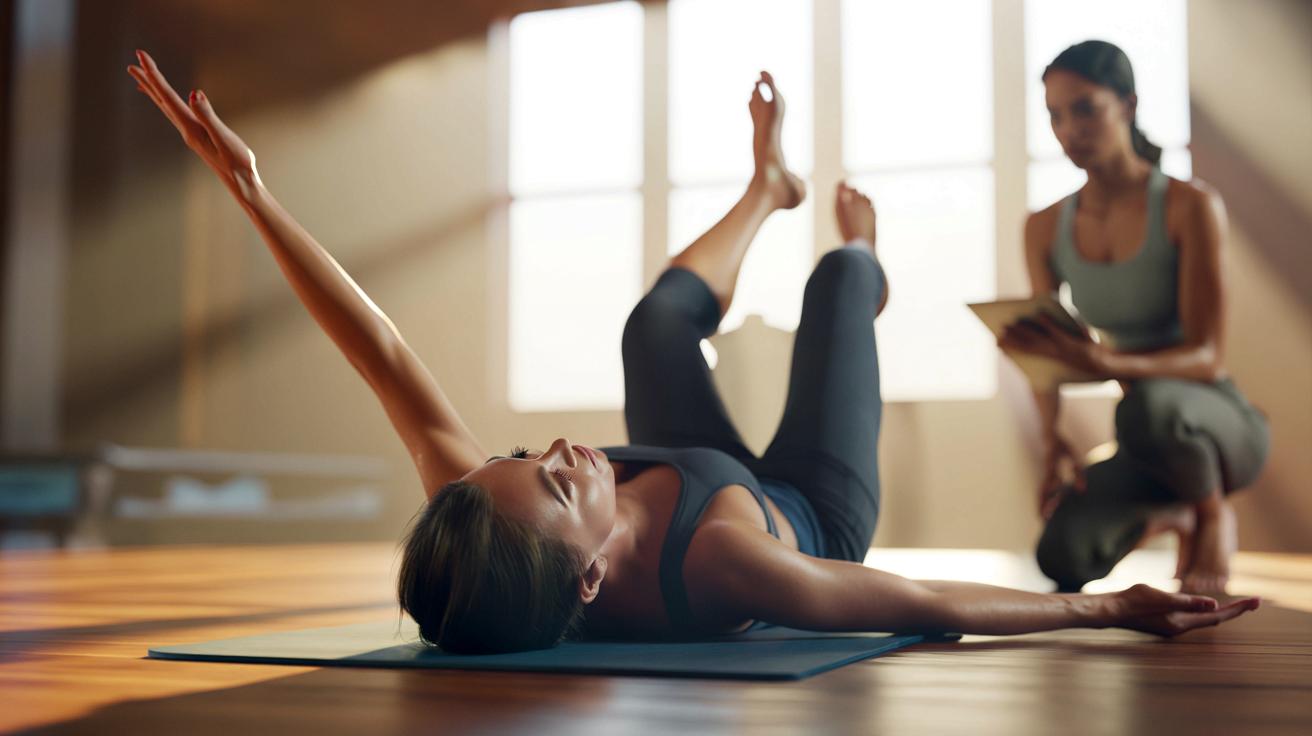
The physio didn’t even look up from her tablet when she said it: “Your deep core isn’t firing.”
I was lying on a treatment table, annoyed, slightly sweaty, convinced my hours of planks and crunches meant my core was the one thing that was actually fine.
Then she asked me to try a very simple yoga pose.
No shaking, no heavy breathing, no dramatic gym music – just a tiny shift I could barely see in the mirror.
And yet my whole midsection lit up like someone had switched on a hidden power grid.
Not the visible abs, but that quiet inner layer that keeps your spine safe and your body stable when life throws you sideways.
That’s when she said: “This is the work almost everyone skips.”
The yoga pose hiding in plain sight
The position she was talking about is one most yoga beginners rush through without thinking: Dead Bug, also known as a variation of supine core work used in many modern yoga and physio flows.
You lie on your back, arms up, knees bent at 90 degrees above your hips, and slowly move opposite arm and leg away from each other.
On paper, it sounds like a warm-up at best.
In practice, when you do it the way physiotherapists teach it, it’s a laser-focused drill for the deep stabilizers that almost every workout glosses over.
A London-based sports physio told me she now gives Dead Bug–style progressions to almost every client with back pain or recurring sports injuries.
Cyclists with tight hips, runners with “mystery” knee pain, office workers who swear their chair is cursed – they all end up on the mat, waving their arms and legs in the air like confused beetles.
She showed me before-and-after videos.
Before: athletes doing heavy squats with wobbly hips and hollowed backs.
After four weeks of consistent Dead Bug work: the same people lifting better, with fewer grimaces and far more control, even though the weight on the bar hardly changed.
Physiotherapists love this pose because it hits the deep transverse abdominis, the multifidus along the spine, and the small stabilizers around the pelvis all at once.
These muscles don’t care about six-pack photos.
They care about keeping your vertebrae stacked, your pelvis neutral, and your joints tracking in a way that doesn’t grind them down.
Most gym moves chase big, obvious muscles: quads, glutes, biceps.
Dead Bug quietly trains the “software” that lets all those bigger muscles work without wrecking you, especially when you’re tired, distracted, or stressed.
➡️ How emotional expectations shape disappointment more than actual events
➡️ Finding gold while digging a pool raises one legal question that decides everything
➡️ The small habit that prevents feeling behind before the day starts
➡️ Foil behind radiators: the installation angle that determines whether you save anything at all
➡️ Baking soda under-eye hacks: the irritation risk nobody mentions and safer options
➡️ Tomato acidity drops with baking soda but so does brightness
➡️ How emotional reactions can be shaped by tone more than content
➡️ Place a single ice cube on your orchid once a week and watch the blooms return
How to do Dead Bug like a physio, not like a rushed warm-up
Start on your back on a firm mat, not a soft sofa.
Bend your knees so they’re stacked over your hips, shins parallel to the floor.
Reach your arms straight up toward the ceiling, wrists above shoulders.
Now the subtle part: exhale gently through the mouth and feel your ribs slide down toward your pelvis.
Your lower back should softly “kiss” the mat, not dig into it.
From here, slowly extend your right leg and left arm away from your center, no lower than you can go while keeping that back connection.
Move at the speed of a slow breath.
Then return to center and switch sides.
Most of us rush the movement, fling our limbs, and arch the back like we’re trying to escape the floor.
That’s when the big outer muscles hijack the work and the deep stabilizers clock out.
Physios often cue their patients to imagine zipping up a pair of tight jeans just below the belly button.
It’s not a hard brace, more of a gentle drawing-in and widening of the waist.
If your neck tenses, your jaw clenches, or your breathing turns into short sips, you’ve gone too far into effort-land.
Let’s be honest: nobody really does this every single day.
Even twice a week, with full attention for five minutes, can change the way your body holds itself standing, walking, or lifting.
One French physiotherapist I spoke with put it bluntly:
“People want flashy exercises and sweat.
What actually protects them is often the boring, precise work they almost laugh at in the beginning.”
To remember the essentials, she jotted them on a Post-it for her patients.
Think of this as the boxed checklist version:
- Keep your ribs heavy and your lower back softly anchored
- Move only as far as you can without losing that anchor
- Breathe slowly, no breath-holding or grimacing
- Quality over quantity: 6–8 perfect reps beat 30 sloppy ones
- Stop if you feel sharp pain in your back or hip, not just muscle fatigue
*Most people fail this exercise not because it’s too hard, but because they rush past the details that make it work.*
Why this “easy” pose quietly changes everything
When you repeat Dead Bug regularly, something subtle starts to shift in daily life.
You twist to grab a bag from the back seat, and your lower back doesn’t complain.
You stand in a long queue and realize your weight is more evenly spread, not sinking into one hip like usual.
These deep muscles are like the quiet colleague who keeps the entire office running while everyone else grabs the glory.
Activate them, and your squat suddenly feels smoother, your yoga balance poses steadier, your runs less jangly.
Ignore them, and all the cute resistance bands and fancy gym shoes in the world don’t quite fix the recurring tight spots.
| Key point | Detail | Value for the reader |
|---|---|---|
| Dead Bug targets deep stabilizers | Transverse abdominis, multifidus, pelvic stabilizers work together | Improves core support beyond visible abs, helping posture and pain |
| Small, slow movement beats big effort | Rib position, breathing, and back contact are the real “load” | Safer for joints, accessible even when injured or tired |
| Consistency matters more than duration | 3–5 minutes, 2–3 times a week can change how your body moves | Realistic habit that fits busy schedules while still protecting your spine |
FAQ:
- Is Dead Bug safe if I have lower back pain?Often yes, and many physios use it for rehab, but start with very small movements and stop if pain spikes; getting a professional assessment is always wise.
- How often should I do this pose to see changes?Most people feel a difference in control or posture within 3–4 weeks doing 2–3 short sessions per week.
- Can Dead Bug replace crunches and planks?It can absolutely be your main core move, especially if you’re prone to neck or back strain with crunches or long planks.
- What if my neck hurts when I do it?Keep your head fully resting on the floor, gaze at the ceiling, and reduce your range of motion; neck tension usually means you’re trying too hard.
- Do I need any equipment?No; later you can add a light weight or resistance band, but the classic version only needs a mat and a bit of focused attention.