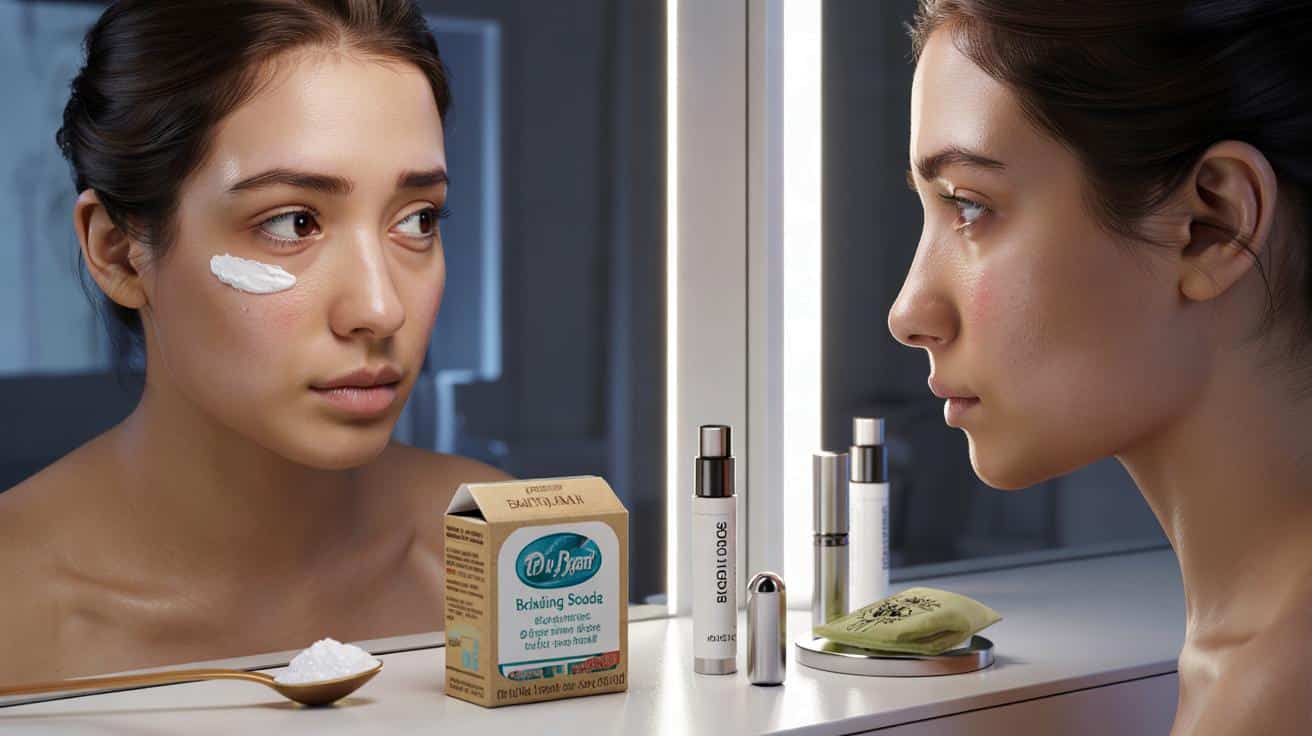
The video is vertical, a little grainy, filmed in a bathroom lit by a single harsh ceiling bulb.
A young woman leans towards the mirror, dark circles prominent, voice whispering that she’s “so over eye bags”. She dips a spoon into a box of baking soda, mixes it with water in a mug, then pats the cloudy paste right under her eyes. Comments explode on screen: “Omg, game changer”, “Trying this tonight”, “Better than Botox?”.
Fast forward ten minutes. The clip cuts to her blinking, skin flushed, the outer corners of her eyes slightly swollen. She laughs it off, calls it “a tiny reaction”, and the video ends with a smiling selfie.
What doesn’t make it into that 20‑second reel is what her under-eyes look like the next morning.
Baking soda under your eyes: why this “miracle hack” burns in silence
The under-eye baking soda trend didn’t come from dermatology clinics or peer-reviewed journals. It came from kitchen cupboards and algorithm-driven feeds where “before/after” thumbnails always win. People see one dramatic transformation, a caption about neutralising acidity or tightening skin, and suddenly half the comments section is planning to smear bicarbonate of soda right up to their lash line.
On paper, it sounds clever. Baking soda is cheap, familiar, sitting next to the salt in most kitchens. It brightens sinks and scrubs pans. So why not do the same to tired skin? The leap feels almost logical when you’re scrolling at midnight, face lit by your phone, noticing your own shadows getting deeper with every video.
What we don’t see is the quiet wave of irritation this “hack” leaves behind: redness, stinging, eyelids that feel like sandpaper. Many people never connect the dots, because the reaction peaks hours later, not in a satisfying on-camera moment.
In real bathrooms, far from ring lights and filters, the story is different. A 32-year-old teacher in Manchester tells friends she tried the hack “just once” on a Sunday night before term started. Her eyes looked “a bit fresher” at first, so she went to bed feeling oddly proud of her DIY facial.
By Monday morning, the skin under her eyes was tight, itchy, and faintly pink. She wrote it off as tiredness. Two days later, the area had turned flaky, almost scaly, and concealer clung to every dry patch. She ended up in a chemist asking the pharmacist, half embarrassed, if “anything for allergies under the eyes” might exist.
There’s no statistics dashboard for these private mishaps. Yet UK dermatologists report a steady drip of cases: contact dermatitis, broken skin barriers, even worsened pigmentation. None of that looks viral on TikTok. A burning under-eye contour doesn’t get the same engagement as a neatly edited “baking soda mask” tutorial with cheerful music.
Under-eye skin is not just “thinner”. It’s structurally more fragile, with fewer oil glands, less cushioning fat, and a barrier that gives up moisture quickly. Introduce baking soda, which has a naturally high pH, and you’re asking this delicate area to wrestle with something your bathroom tiles can barely handle gracefully.
➡️ Place a single ice cube on your orchid once a week and watch the blooms return
➡️ He hid an AirTag in his donated sneakers and tracked them to a surprising location
➡️ Orcas near ice shelves: what researchers track that signals real behavior change
➡️ Perfume fades faster on some people for a biological reason unrelated to skin type
➡️ Tomato acidity drops with baking soda but so does brightness
➡️ The small habit that prevents feeling behind before the day starts
➡️ Foil behind radiators: the installation angle that determines whether you save anything at all
Skin likes a slightly acidic environment, hovering roughly between pH 4.7 and 5.5. Baking soda lands around pH 8–9. That jump might not sound dramatic, but for your skin barrier, it’s a chemical shove. Natural enzymes that keep your barrier balanced start misfiring. Lipids that hold skin cells together loosen up.
*On thicker areas like elbows or heels, you might get away with the occasional DIY scrub.* Under the eyes, where the epidermis is up to five times thinner, the same mix can mean micro-tears, heightened sensitivity, or a lingering burning sensation. And if that paste creeps into the actual eye? You’ve just put an alkaline irritant directly against one of the most sensitive tissues in your body.
Safer ways to brighten under-eyes without starting in the baking aisle
If the aim is to look more awake, there are gentler routes that don’t involve raiding your cupboard. One of the simplest is cooling. A chilled teaspoon pressed lightly under the eye for a minute can reduce puffiness by constricting tiny blood vessels. It won’t erase genetic dark circles, but it can calm that “I slept four hours” swelling that shows up on video calls.
Another precise move: caffeine eye serums applied with a metal rollerball. Caffeine, in low percentages, can temporarily constrict blood vessels and reduce fluid build-up. A pea-sized amount, dabbed under the eye (never on the mobile lid), then tapped in with the ring finger, delivers a small, targeted boost. No foaming, no fizzing, no kitchen chemistry required.
Longer term, brightening ingredients at the right strength matter more than any viral paste. Think low-dose vitamin C around 5–10%, or niacinamide around 2–5% in formulas specifically labelled safe for the eye area. Used a few times a week, they can help with uneven tone without stripping the skin barrier the way an alkaline powder can.
Most people don’t dab baking soda under their eyes because they love risk. They do it because they’re tired, self-conscious, and drowning in content that tells them every fine line is a personal failure. On a bad day, one “miracle hack” caption can feel like a lifeline. You’re not alone if you’ve hovered with a spoon over a bowl of white powder thinking, “What if this actually works?”
Here’s the thing no one mentions in those snappy clips: under-eye care is boring by design. The products that truly help tend to act slowly, with small changes over weeks, not minutes. Soyons honnêtes : personne ne fait vraiment ça tous les jours. Life gets in the way, school runs get in the way, scrolling gets in the way.
If you’ve already tried baking soda and your under-eyes feel sore, your first move isn’t to panic. Stop everything active. Reach for a bland, fragrance-free moisturiser and a cool compress. Give your skin a few days to calm down before reintroducing anything beyond simple hydration.
“When a £1 box of baking soda is going near your eyes, ask yourself why an entire field of dermatology somehow ‘missed’ this miracle,” says one London-based consultant dermatologist with a dry smile. “If it really worked safely, you’d see it in clinics, not only in trending audio.”
Some quick swaps make a quiet, real-world difference:
- Swap baking soda paste for cooled chamomile tea bags (if you’re not allergic) to reduce puffiness.
- Swap harsh scrubs for soft microfibre cloths soaked in lukewarm water to remove eye makeup.
- Swap random kitchen hacks for eye creams tested for ophthalmic safety and fragrance-free formulas.
There’s also the mental swap: from “fixing” your face overnight to supporting it over time. That doesn’t sound nearly as exciting as a viral hack. Yet for most readers, especially those with sensitive or darker skin tones prone to pigmentation, it’s the difference between a calm under-eye area and months of dealing with redness that won’t quite go away.
The quiet power of saying no to risky hacks
There’s a subtle courage in scrolling past a trending trick and thinking, “Not on my face.” It’s the kind of tiny daily decision that never goes viral, because there’s no dramatic before/after, no gasp-inducing transformation. Just you, your mirror, and under-eyes that might be a bit creased, a bit shadowed, but not on fire.
On a human level, the baking soda story is less about chemistry and more about how we deal with insecurity in public. We’re watching strangers film their most vulnerable angles, then reaching for whatever they used, hoping the same product will erase our own tiredness, our own history. The product changes every season; the feeling underneath rarely does. On a Sunday night, after a long week, who wouldn’t be tempted by a “two-ingredient hack” promising to rewind the clock?
What happens if we treat our under-eyes not as a problem to be scrubbed away, but as evidence that we’re living, working, laughing, not sleeping quite enough? That doesn’t mean giving up on care. It means choosing habits and products that stand a chance of helping in six months, not just in six seconds on camera. Maybe that’s sharing a post that says, “Hey, skip the baking soda, try this instead,” or simply telling a friend that their eye bags don’t need fixing at all.
| Point clé | Détail | Intérêt pour le lecteur |
|---|---|---|
| Baking soda irrite l’œil | pH trop alcalin pour la peau fine du contour de l’œil, risque de brûlure et de sécheresse | Comprendre pourquoi le hack viral peut aggraver cernes et ridules |
| Options plus douces existent | Froid, caféine, vitamines à faible dose, soins testés pour le contour de l’œil | Disposer de solutions concrètes pour paraître plus reposé sans se blesser |
| Le temps joue pour vous | Habitudes régulières, hydratation, sommeil et filtres solaires protègent sur la durée | Se projeter dans une routine réaliste plutôt qu’un miracle instantané décevant |
FAQ :
- Is it ever safe to use baking soda under the eyes if I dilute it a lot?Even heavily diluted, baking soda shifts the pH of that fragile skin in the wrong direction and can sting or dry it out, so it’s better kept away from the eye area entirely.
- What should I do if I already put baking soda under my eyes and it burns?Rinse gently with plenty of lukewarm water, stop all active products, apply a bland moisturiser, and if there’s strong pain, swelling, or vision changes, seek medical help quickly.
- Can baking soda at least help with milia or tiny bumps around my eyes?Those small white bumps usually need time, gentle exfoliation with eye-safe products, or professional extraction, and harsh DIY mixes can actually make them worse.
- What ingredients are genuinely helpful for dark circles?Depending on the cause, low-dose vitamin C, niacinamide, caffeine, peptides and daily SPF can gradually improve colour and texture, especially when combined with better sleep and less rubbing.
- Are “natural” remedies like lemon or vinegar any better than baking soda under the eyes?Highly acidic kitchen ingredients can be just as irritating in the opposite direction, so anything from the pantry is best kept on your plate, not on your eyelids.