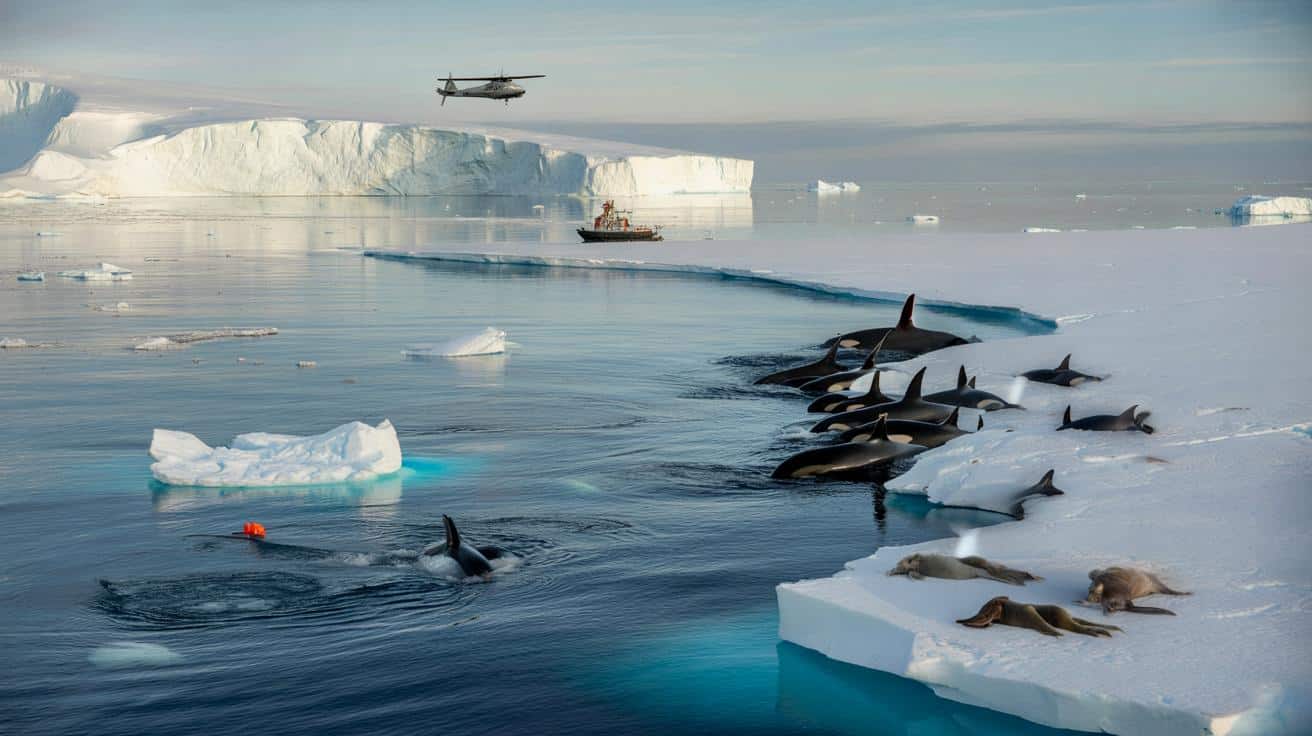
The sea looks flat from the helicopter window, a sheet of pewter broken only by white floes and the hard blue edge of an ice shelf.
Then a black curve breaks the surface. Another. A tight cluster of dorsal fins moves along the ice, like a patrol. The pilot dips a wing so the researchers can film. Below, the orcas are clearly not just passing through. They are scanning, circling, testing cracks in the ice.
On the headset, a scientist’s voice cuts in: “They were never here in these numbers ten years ago.” No one answers. Everyone is watching the GPS tracks on the tablet light up like scribbles along the ice margin. The orcas turn again, lining up with a lead that opened last week. It looks almost like a new coastline to them. One question hangs in the cabin air.
What exactly are these whales changing – and how do we really know?
What orcas near ice shelves are actually doing differently
From a distance, orca behavior can look timeless: black-and-white shapes surfacing in breathy rhythm, mist hanging in the cold air. Yet when researchers zoom in on pods near ice shelves, the pattern doesn’t quite match the stories in old field notes. Animals are hugging the ice edge longer. They are arriving earlier in the season. Some pods are pushing into bays that used to be locked in fast ice all year.
To a tourist on a ship’s deck, it’s just “more whales”. To a scientist with a notebook, it’s a series of long, thin clues. Who is present. How long they stay. Where they turn back. Those clues are being logged like a detective case. Because when ice disappears or fractures in new ways, orcas are among the first big predators to test the new map.
One field team in the Antarctic Peninsula began seeing a new pattern on their satellite tags in 2016. A group of Type B orcas, usually spread over tens of kilometres, started bunching tightly along a retreating ice shelf front. Instead of their classic sweeping loops offshore, their GPS tracks formed sharp zigzags close to the ice edge. In the drone footage, they coordinated attacks on seals resting on small floes, tilting the ice by rushing in unison.
Before, those seals would have been higher up on thick, stable ice. The pod is now exploiting a looser, more fragmented icescape. The researchers went back to older tag data from the 2000s. Those older tracks showed broad, lazy arcs through heavier pack ice, not this concentrated grid of hunting lines. The shift isn’t just a feeling; it is drawn literally in the movement data.
To make sense of these changes, scientists slice orca behavior into measurable pieces. They track travel speed, dive depth, group spread, hunting formations, and how these line up with ice charts from satellites. If a pod suddenly spends twice as much time near an ice front after a shelf has broken up, that’s a red flag for real behavioral change. *Not a random good feeding day, but a new habit forming.* When that pattern repeats across years and different pods, the story hardens: the orcas are rewriting their relationship with the ice.
The hidden signals researchers watch in the frozen margins
Behind every striking wildlife clip on social media, there’s usually someone in a cold lab staring at graphs. For orcas near ice shelves, those graphs begin with tags. Researchers attach small devices with suction cups to the whales’ backs. For a few hours or days, each tag records GPS position, dive depth, temperature, and sometimes even sound. It’s like strapping a Fitbit to a top predator.
From these tags, one key signal is “time near the ice edge”. Not just a rough guess, but minutes and hours spent within a narrow band around the shelf front. When that number creeps up year after year, while the ice itself pulls back or fractures, it suggests orcas are following the retreat – or even getting ahead of it. They’re not just passing through; they are staking out new hunting ground where thick ice used to say “no entry”.
➡️ How emotional reactions can be shaped by tone more than content
➡️ Baking soda under-eye hacks: the irritation risk nobody mentions and safer options
➡️ How emotional expectations shape disappointment more than actual events
➡️ Foil behind radiators: the installation angle that determines whether you save anything at all
➡️ Place a single ice cube on your orchid once a week and watch the blooms return
➡️ Finding gold while digging a pool raises one legal question that decides everything
Another powerful signal comes from how tightly whales cluster. In West Antarctica, a long-running study compared old aerial photos with recent drone footage. Older images showed orcas spread out, often in loose lines parallel to the ice. In newer footage, some pods compress into tight “hunting balls” near cracks and leads. The spacing between individuals shrinks. Instead of meandering, they perform choreographed rushes at floes carrying seals or penguins.
This isn’t only visible from above. Hydrophones anchored under the ice pick up shifts in vocal behaviour. More calls, more overlapping clicks, and moments of sudden silence. In one bay, as sea ice thinned, scientists recorded a spike in high-energy, burst-pulse calls associated with coordinated hunting. At the same time, the seasonal window when those calls appeared widened by several weeks. The orcas weren’t just louder; they were “on the job” for longer each year.
To separate a true behavior change from the normal chaos of the ocean, researchers lean hard on repetition. One strange year can be a fluke. So they look for three things lining up: altered movement patterns, new timing, and consistent use of fresh areas. If orcas start arriving two weeks earlier, then consistently spending more time near a freshly exposed ice front, and adopting dense, coordinated hunting formations there, the odds of coincidence fall fast.
That’s where long-term projects matter. Datasets reaching back 20 or 30 years allow scientists to say: this is not how these whales behaved when ice shelves were stable. Soyons honnêtes : personne ne fait vraiment ça tous les jours, mais the teams who keep going back, year after year, are the ones catching the pivot. They’re the ones who can point at a line on a chart and say, quietly, “Here. This is where the story changes.”
How to read the “code” of orca behavior without a PhD
You don’t need polar boots or a research grant to get a feel for how scientists spot real change. The first trick is to think in patterns, not moments. An impressive video of orcas washing a seal off an ice floe is dramatic, sure. The real question is: are they doing that more often near ice shelves than they used to, and in more places?
So researchers treat every observation like a tile in a mosaic. They tag locations, note the ice type, count how many whales are present, log what they’re doing. As satellite ice maps become public, anyone can overlay whale sightings on the changing ice edge. That’s how keen observers and local guides sometimes give scientists their first hints. A captain who’s been running the same cruise route for 15 years saying, “We never used to see them this far south in November,” is quietly describing a behavior shift.
On a personal level, the method is almost the same as noticing birds visiting your garden at different times of year. You watch the calendar. You remember where they land, how many there are, what they eat. Tiny changes click into place over seasons. On a frozen coastline, the stakes and the scale are bigger, but the basic human skill is the same. On a ship’s bridge at midnight, with radar glowing softly, someone is doing exactly that: watching, comparing, filing away the differences.
There’s a gentle trap a lot of us fall into: expecting instant, dramatic proof. One viral clip, one study, and we decide orcas have completely changed their ways. The truth is slower, messier. Field teams miss days because weather shuts them down. Tags fall off. Orcas vanish into heavy ice for weeks. So scientists talk about probabilities and trends, not certainties delivered on a plate. They make mistakes, correct them, and start again.
On a more emotional note, we’ve all had that moment where we realise a familiar place doesn’t behave like it used to – a river that no longer freezes, a beachline creeping closer to the road. That same unease runs through the orca work. The ice shelves set the stage. As the stage shifts, the actors improvise. Sometimes they thrive, sometimes they don’t. **Researchers are trying to read those improvisations before the script gets too far ahead of us.**
One marine ecologist told me during a long night watch,
“We’re not just tracking whales. We’re watching an entire ocean learn a new set of rules.”
To keep that bigger picture in mind, teams often collect simple, repeatable notes:
- Where orcas appear relative to the ice front (distance and direction).
- How tightly they group and what formations they use near floes.
- Whether hunts focus on seals, penguins, or fish in open leads.
- What the ice looks like that day: solid shelf, broken floes, wide leads.
- How the timing compares with past years on the same stretch of coast.
Those plain details, written with cold fingers on a rocking ship, become the bones of bigger stories. Over time, they help answer the uncomfortable question humming under all this: as the ice changes, who adapts, who follows, and who gets left behind.
What these changes might mean for us
Sitting at home scrolling on a phone, it’s tempting to file all this under “faraway nature”. Orcas, ice shelves, satellite tags – it can feel like a different planet. Yet what researchers are really tracking is the pace at which a powerful predator adjusts to a reshaped world. That pace tells us something about speed, resilience, and limits.
When orcas quickly exploit thinner ice and longer open-water seasons, they don’t just change their own routines. They alter the pressure on seals, penguins, and fish that depended on that ice buffer. Food webs flex, sometimes snap. **For scientists, behavior change is a living warning light**, flickering before population crashes or sudden shifts in who dominates a region. Watching orcas is one way of asking: how fast can life reorganise when the physical rules change?
There’s also a deeper, less technical layer here. Many coastal communities and Indigenous observers have their own long memory of sea-ice and whale behavior. Their stories, read alongside tagged tracks and drone images, add texture modern instruments can’t catch. A hunter noticing orcas appearing in “the wrong bay” in early spring is flagging the same disruption a satellite later confirms. Two kinds of knowledge, both tracking the same unease.
For readers, the takeaway isn’t to become instant experts on Antarctic ecology. It’s to recognise that behavior is often the first visible ripple of a bigger shift. An orca pod hugging an ice shelf for longer, calling differently under thinning floes, isn’t just an amazing spectacle. It’s a data point in a global negotiation between climate, ice, and the creatures that live at their edge.
| Point clé | Détail | Intérêt pour le lecteur |
|---|---|---|
| Orcas follow the moving ice edge | Tags show whales spending more time close to retreating ice shelves | Helps you see orcas as active responders to climate shifts, not fixed icons |
| Behavior change is measured, not guessed | Researchers track timing, group patterns, and hunting tactics over decades | Gives confidence that “change” is based on data, not isolated anecdotes |
| Small signals add up to big stories | Individual sightings, local knowledge and long-term datasets converge | Invites you to value careful observation in your own environment |
FAQ :
- Are orcas near ice shelves increasing in number?In some regions, more sightings are linked to easier access as ice retreats, but that doesn’t always mean the total population is rising; it can be a redistribution.
- How do scientists tag orcas without harming them?They use temporary suction-cup tags fired from a pole or air gun at close range; the tags fall off after hours or days and are designed not to pierce the skin.
- Why do orcas seem attracted to ice edges?Ice margins often concentrate prey like seals and fish, especially where new leads expose feeding opportunities that didn’t exist when the ice was thicker.
- Can tourists or cruise passengers help this research?Yes, some projects collect geo-tagged photos and sighting logs from ships, which can complement scientific surveys and fill observation gaps.
- Does orca behavior change prove climate change on its own?No, but when combined with ice data, temperature records and long-term trends, shifting orca patterns become another strong piece in the climate puzzle.