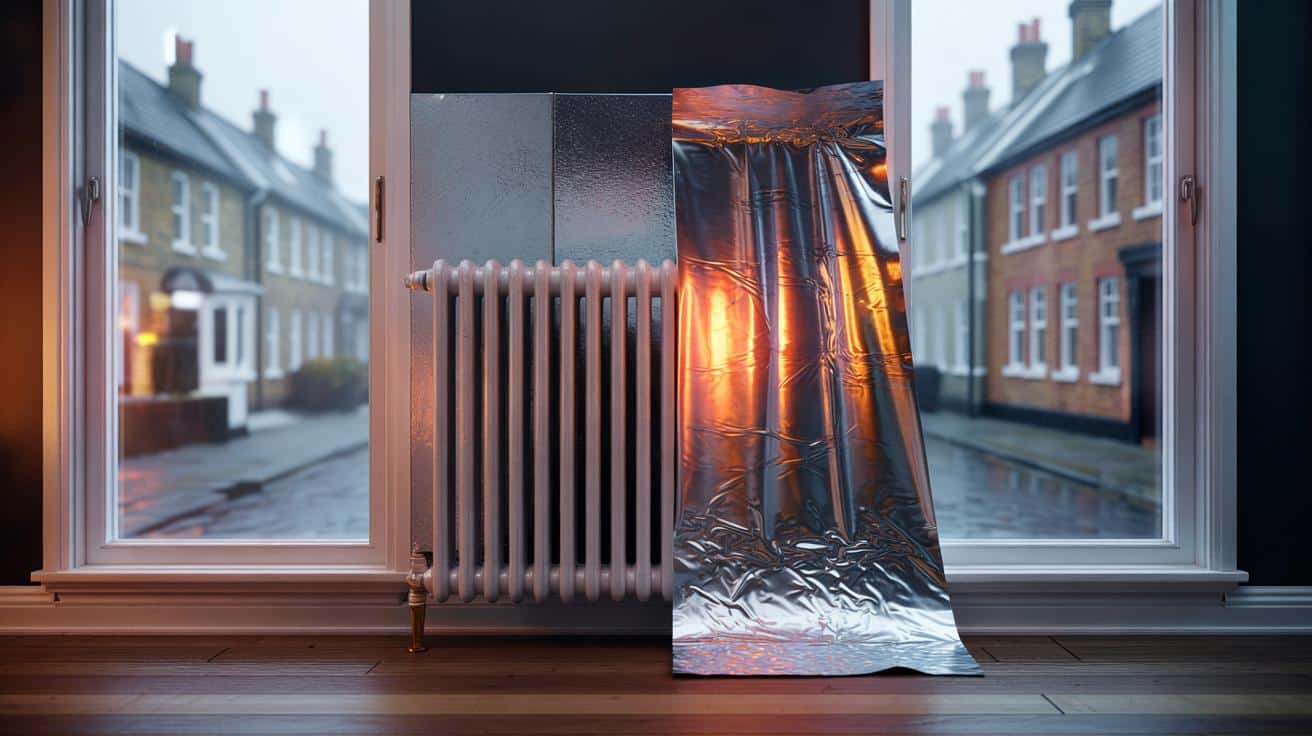
The foil crackles softly as Mark tries to smooth it behind the living‑room radiator.
The heating’s on low, a grey January afternoon hanging over the street, and he’s half listening to a podcast about “easy energy wins”. The presenter claims this shiny sheet could knock a chunk off his gas bill. Mark frowns, squints, then sticks the tape down at a slightly sagging angle.
He steps back, arms folded. Hard to tell if he’s done it “right”. The packet showed a neat, perfectly flat panel. His version looks more like a crisis blanket from a marathon finish line. Still, he tells himself, heat is heat. The foil’s there, so it must be helping. Right?
What nobody tells him is that with radiator foil, the angle isn’t a detail. It’s the whole story.
Why some radiator foil saves money… and some does almost nothing
Walk down any British street in winter and you’ll see the glow of radiators through thin curtains. Behind many of them, hidden and crumpled, sit those silvery sheets that promise “up to 20% savings”. In reality, the difference between a win and a waste often comes down to how that foil is facing, and what it’s actually reflecting.
Radiators don’t work like tiny fan heaters. A big chunk of what they give off is radiant heat, like gentle sunshine on your skin. That heat travels in straight lines. If the foil is leaning the wrong way, or not where the radiator can “see” it, a lot of that energy will still dive straight into a cold outside wall instead of bouncing back into the room. The physics doesn’t care about the packaging claims.
Energy advisers quietly admit this. In monitored homes, well‑installed foil behind radiators on uninsulated external walls can help, but only modestly. Often we’re talking single‑digit percentage gains, not miracle cuts in half. And there’s a catch: the foil has to sit tight and flat, with the reflective face pointing straight towards the radiator panels. Tilt it too much, crumple it, or let it hang low and most of that precious heat just finds a new path into the brickwork.
A housing officer in Leeds once told me about two identical terraces on the same street. Both families bought cheap radiator foil from the same DIY shop. One took an afternoon, removed each radiator carefully, fitted rigid foil boards snug against the wall, and rehung everything. The other slid strips down from above, letting them flop wherever they landed, then posted about their “eco upgrade” on Facebook.
When the council did thermal imaging that winter, the pictures were brutal. In the first house, the outside walls behind radiators glowed a cooler shade on the camera, meaning less heat escaping. In the second, the images looked almost unchanged. The foil was there, technically, but half of it was bent away, reflecting heat up towards the window sills or back into gaps in the plaster. The angle was wrong, so the reflection was wrong, so the savings were… basically theoretical.
We like to think of insulation as a yes/no thing – either you have it or you don’t. Radiator foil exposes the lie in that thinking. This stuff isn’t magic wallpaper; it’s a mirror for heat. And mirrors rely on angles. Radiant heat beams hit the foil, then bounce away at the same angle they arrived, just like a torch on a bathroom mirror. If the sheet leans away at the top, those beams shoot down into the skirting or up behind your window ledge. Only when the foil stands almost parallel to the radiator, forming a narrow, shiny “corridor” of air, does a meaningful share of that warmth get nudged back into the room instead of into the brick.
The installation angle that actually works for radiator foil
The most effective set‑up is boringly precise. The foil needs to be as vertical as your wall allows, flat, and close behind the radiator without actually touching it. Think of creating a clean, reflective panel that faces the radiator like a mirror faces your face. Any obvious lean turns that mirror into a misfire for heat.
➡️ Finding gold while digging a pool raises one legal question that decides everything
➡️ Snakes appear in gardens because food sources move in first
➡️ He hid an AirTag in his donated sneakers and tracked them to a surprising location
➡️ Orcas near ice shelves: what researchers track that signals real behavior change
➡️ Perfume fades faster on some people for a biological reason unrelated to skin type
➡️ How emotional reactions can be shaped by tone more than content
For standard panel radiators on an outside wall, the sweet spot is usually a few centimetres gap between radiator and foil, with the sheet taped or clipped firmly to the wall. *Not* draped from the brackets, not bowed out at the bottom, not rolled inside out so the dull side faces the heat. The reflective surface must look directly at the back of the radiator fins. That alignment decides whether the radiant heat is nudged back into the room or slips sideways into nowhere useful.
On a practical level, that often means cutting rigid foil‑backed boards instead of relying on flimsy roll foil that sags over time. Where pipes and brackets get in the way, people tend to snip around them and leave gaps. Those gaps become little escape routes for heat. The more of the visible radiator area the foil “sees” at a clean, near‑parallel angle, the more chance you have of making the product actually earn its keep.
This is where most households fall down, and it’s rarely laziness. On a cold evening, you just want something quick that feels proactive. Many people slide foil down from the top because it avoids taking radiators off the wall. It looks ingenious in a TikTok clip, but gravity ruins the geometry. Over a few weeks, the sheet slumps at a slope, creating that tell‑tale triangle of dead space at the bottom. That’s the point at which the real savings quietly fall off a cliff.
On a rented flat, the temptation is even stronger to “just tuck it in and hope”. Nobody wants a long argument with a landlord about brackets and screws. So we improvise, and the foil ends up folded, bent, twisted around pipes – anywhere except where the heat actually needs it. Soyons honnêtes : personne ne fait vraiment ça tous les jours. Nobody is checking those angles once the heating goes on and life gets busy.
One energy advisor I spoke to put it bluntly:
“Foil behind radiators only pays its way when it’s treated like a small engineering job, not a craft project. If the angle’s wrong, you’ve just decorated the back of your radiator.”
That might sound harsh, yet it matches what the data shows in test homes. Where people took the time to keep the foil upright, taped firmly, and sized to the full radiator width, you see a modest but real reduction in heat lost through cold external walls. Where the foil slumped, wrinkled, or bent towards the floor, any benefit dropped into the measurement noise.
- Keep it upright: Foil should stand as vertical as the wall, not leaning in or out.
- Face the heat: Shiny side towards the radiator, dull side against the wall.
- Cover the area: Match the width and height of the active radiator surface where you can.
Once you’ve seen heat as straight‑line beams instead of a vague “cosy glow”, those steps feel less like fussy perfectionism and more like basic common sense.
So is radiator foil worth it, or just shiny guilt‑management?
There’s a quiet honesty emerging among people who’ve tried every hack. Radiator foil isn’t a hero. It’s a supporting act. On badly insulated external walls, fitted with care and at the right angle, it can be a cheap way to stop throwing quite as much money through the bricks. On internal walls, or where the foil is just dangling in strange shapes, it’s mostly theatre.
The more interesting part is what the whole debate says about how we treat our homes. We reach for easy, “one afternoon” fixes long before we’ll seriously look at cavity wall insulation, draught‑proofing, or zoning our heating. Radiator foil scratches the itch of doing something right now, with scissors and tape, on a rainy Sunday. On a human level, that matters. On a kilowatt‑hour level, the payoff is fragile, and the installation angle is the thin line between “helpful nudge” and “nice idea on paper”.
On a cold weekday morning, when the heating clicks on before sunrise, nobody is thinking about reflected heat geometry. You’re thinking about school runs, Teams calls, toast. Yet behind those white metal panels, the laws of physics quietly get on with their work. The wall either drinks in your warmth or sends some of it back, depending on the exact slant of a shiny sheet you forgot you installed. That tiny, unseen angle decides whether the foil behind your radiator is quietly earning its place – or just hanging there, reflecting nothing that reaches you.
| Point clé | Détail | Intérêt pour le lecteur |
|---|---|---|
| Angle vertical | Foil should sit flat and parallel to the radiator, not sloping | Maximises the amount of radiant heat reflected back into the room |
| Shiny face orientation | Reflective side towards the radiator, dull side to the wall | Ensures the material behaves like a “heat mirror” rather than dead lining |
| Wall type & coverage | Best on uninsulated external walls, covering the full radiator area | Helps decide where foil is worth the effort and where it’s mostly cosmetic |
FAQ :
- Does radiator foil really save money on heating bills?It can, but only modestly and mainly on radiators fixed to cold external walls. Savings tend to be single‑digit percentages, and only when the foil is installed flat, vertical, and facing the radiator correctly.
- What is the ideal angle for foil behind a radiator?The foil should be as close to perfectly vertical as your wall allows, running parallel to the back of the radiator. Any noticeable lean sends heat away from the room rather than back into it.
- Is it worth using foil on internal walls too?Usually not. Radiators on internal walls mostly heat rooms within the same thermal envelope, so there’s less benefit in reflecting heat back. Your money and effort are better spent on external walls, draught‑proofing, or better controls.
- Can I just slide foil down behind the radiator without removing it?You can, but the results are hit‑and‑miss. Slid‑in foil often sags at an angle over time. If you can’t remove the radiator, cut stiff panels that sit tight against the wall and fix them securely so they stay upright.
- What type of foil works best behind radiators?Foil‑faced rigid boards or purpose‑made radiator reflector panels generally work better than thin kitchen foil. They stay flat, hold the right angle, and are easier to cut to the full radiator size without crumpling.