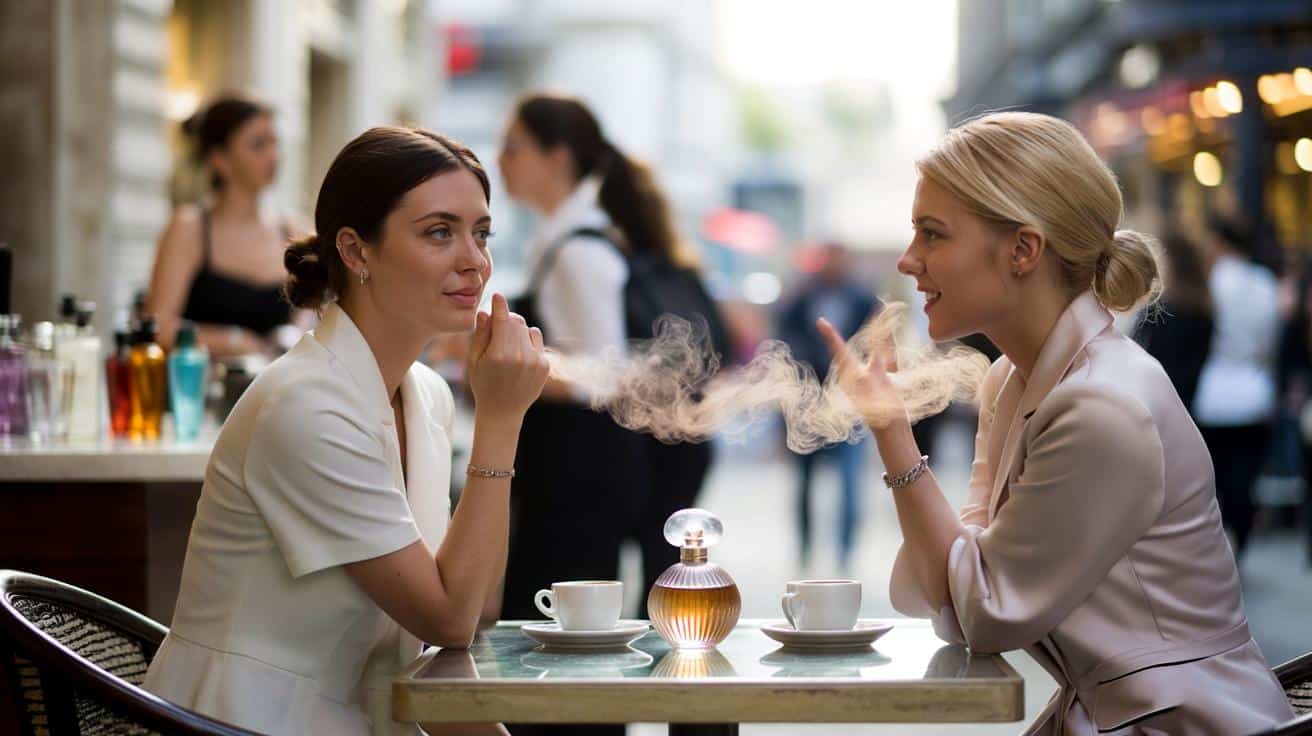
The woman at the café smelled like warm vanilla and suncream when she walked in.
Fifteen minutes later, nothing. Her perfume had vanished into the hum of the espresso machine and the smell of toasted bread. Two tables away, another woman’s woody iris trail still floated in the air long after she’d left her chair. Same crowd, same room, same time of day. Two completely different stories on the skin.
People often think it’s all about “dry skin” or the price of the bottle. Rich friends complain their £150 fragrance disappears by noon. Others wear a cheap classic that clings stubbornly to their jumper until the next wash.
What if the real reason your perfume vanishes has nothing to do with your skin type at all? What if the answer is quietly hiding in your body chemistry, far beneath the surface?
Why your perfume disappears while your friend’s lingers
Perfume doesn’t just sit on you. It negotiates with you. When fragrance molecules land on your skin, they run into a crowded party of enzymes, hormones, bacteria and tiny oil droplets. Some skins say, “Welcome, stay a while.” Others slam the door almost immediately.
Perfumers quietly talk about “fragrance eaters”: people whose bodies break down scent with brutal efficiency. That talent lives largely in your biology, not in the moisturiser you used this morning. We’re talking about how fast your body processes tiny aromatic compounds, especially through enzymes linked to your metabolism and, surprisingly, your sense of smell.
On a hot commute, you can almost watch this difference play out. One person’s citrus splash evaporates before the train leaves the station. Another’s smoky oud follows you down the carriage like a ghost. The scent didn’t just fly away; your body helped decide its fate.
On a Friday evening in London, Emma and Zoe get ready at the same mirror. Emma wears a niche amber extrait. Zoe sprays a light floral mist. Two hours later in the bar, Zoe still smells like a spring garden. Emma leans in and whispers, half‑annoyed, half‑amused: “Mine’s gone already. Again.”
They start testing it. Same perfume, different wrists. They do this several times over a month. Each time, the pattern repeats. On Zoe, the scent stretches comfortably to late night. On Emma, top notes flash, heart notes flicker, and by dessert the whole thing has all but disappeared.
They try what the internet says: more lotion, pulse points, even spraying clothes. It helps a bit, yet the gap remains. When Emma chats with a dermatologist friend, she hears something that changes everything: this isn’t really about “dry skin” at all. It’s about how her body chews through volatile molecules, right down to her genes and hormones.
Scientists have been studying how we metabolise scent molecules using some of the same pathways we use for medicines and toxins. Certain enzymes, especially in the cytochrome P450 family, act like little factory workers breaking down anything foreign, including perfume ingredients. Some people naturally have more active versions of these enzymes. Their bodies are quick to slice up fragrance molecules, so the smell fades faster.
➡️ Foil behind radiators: the installation angle that determines whether you save anything at all
➡️ He hid an AirTag in his donated sneakers and tracked them to a surprising location
➡️ Place a single ice cube on your orchid once a week and watch the blooms return
➡️ How emotional expectations shape disappointment more than actual events
➡️ Finding gold while digging a pool raises one legal question that decides everything
There’s another twist: your sense of smell sits in your brain, not your skin. People with very sensitive noses often “go nose blind” to their own perfume long before others do. Hormonal fluctuations – due to menstrual cycles, thyroid issues, medication or stress – can change both how much sebum you produce and how your olfactory receptors fire. So the scent may still be there, but your brain quietly turns down the volume, making you think it has vanished.
So this “disappearing act” becomes a double act: your metabolism is dismantling the perfume, while your brain is learning to ignore what’s left.
How to work with your biology instead of fighting it
Once you accept that your body chemistry has a say, you can start playing smarter. The first move: change the structure of what you’re wearing, not just the amount. Fragrances rich in heavy base notes – woods, amber, resins, musks, vanilla – last longer because their molecules are larger and slower to evaporate.
If you’re a “fragrance eater”, swap airy colognes and ultra‑sheer mists for eau de parfum, parfum or extrait versions of similar scents. Spray on the back of your neck, under your hairline and lightly on clothing, where enzymes and heat have less access. A tiny dab on the inside of your blazer lapel often outlives any spritz on bare skin.
Think of it less as “more perfume” and more as *smarter placement* against your natural chemistry.
Most people in the fast-scroll world want one magic hack. Reality isn’t so tidy. There are small habits that help, especially if your body tends to devour scent. Moisturising before spraying gives fragrance a more stable surface, but the trick is texture: go for a neutral, fragrance-free cream or oil where the scent can latch on without competing notes.
Another quiet ally: temperature. Spraying right before stepping into glaring heat or intense exercise speeds evaporation. Give your fragrance a few calm minutes on skin at room temperature before you hit the chaos of your day. And spread your sprays. Two light mists in different places often outlast six panicked pumps in the same spot.
Soyons honnêtes : personne ne fait vraiment ça tous les jours. Yet if you pick one or two rituals you can keep – moisturise, smart placement, heavier formulas – the difference can feel almost unfair.
There’s also the emotional side, the subtle punch of spraying something beautiful and watching it vanish. Many people quietly take it personally, as if their skin is “wrong” or rejecting luxury. It isn’t. It’s simply efficient at doing what it’s meant to do: process what lands on it and keep things moving.
“The goal isn’t to force perfume to behave,” says one London perfumer. “It’s to find the point where your biology and the formula shake hands instead of wrestle.”
Instead of chasing that one mythical “long-lasting” scent, it can help to build a tiny wardrobe that suits your particular chemistry: one resinous evening scent, one musky skin fragrance for close encounters, one brighter choice that you’re happy to re-spray.
- Choose richer concentrations (EDP, extrait) if your scent disappears fast.
- Favour woody, amber, resinous and musky bases over ultra-fresh colognes.
- Layer: unscented cream, then perfume, then a light mist on clothes.
- Give your nose a break; don’t keep sniffing the same spot all day.
- Accept that some perfumes won’t work on you – and that’s not a failure.
Living with a body that “eats” perfume
There’s a quiet relief in understanding that your vanishing fragrance isn’t a character flaw or a sign you bought the wrong bottle. It’s just your biology doing its own fast-forward edit. Once you know that enzymes, hormones and your brain’s filter are co-writing the script, the whole story shifts from frustration to curiosity.
You may start noticing patterns. Certain perfumes stick to your scarf but not your wrists. Some only appear in little flashes when you move, like a memory catching the light. You might realise that you’re not losing your perfume as much as wearing it in a different, more intimate way than the people who leave a loud trail.
On a crowded train, that can actually feel like a superpower. Your fragrance becomes a secret, more for you and the people close enough to hug than for the entire carriage. And yes, you can still want more longevity. But maybe the real win is learning how your body edits perfume – and choosing scents that sound good in your personal mix.
| Point clé | Détail | Intérêt pour le lecteur |
|---|---|---|
| Biologie vs “peau sèche” | Enzymes, hormones et cerveau jouent un rôle majeur dans la tenue | Arrêter de culpabiliser et comprendre la vraie cause |
| Choix de formules | Privilégier bases boisées, ambrées, musquées, concentrations plus fortes | Faire des achats plus malins et rentables |
| Stratégie d’application | Hydratation neutre, placement sur vêtements et zones moins chaudes | Gagner plusieurs heures de tenue sans vider le flacon |
FAQ :
- Why does my perfume vanish in an hour while others last all day?Likely because your body breaks down fragrance molecules faster and your brain adapts quickly to the smell, so it feels gone even when others still notice it.
- Is it really not about having dry or oily skin?Skin moisture plays a role, but enzymes, hormones and olfactory sensitivity often have a bigger impact than basic “skin type”.
- Can I change my biology so perfume lasts longer?You can’t rewrite your genes, but you can work around them with heavier formulas, better placement and layering on moisturised or clothed areas.
- Do long-lasting perfumes mean they’re stronger or more “chemical”?Not automatically. Longevity usually comes from heavier base notes and higher concentration, whether the ingredients are natural, synthetic or a mix.
- How do I know if my scent is really gone or if I’m just nose blind?Ask someone you trust to smell from a polite distance a few hours after spraying, or smell your clothes that evening; if they still carry the scent, your brain just tuned it out.